Echo
Feedback & Q&A
Echo is Gythr's feedback layer. Session ratings, sponsor feedback, live Q&A, and event-level pulse checks, captured in the moment, protected by real privacy rules, and delivered to organizers and speakers without ever exposing individual attendees. Honest signal. No identity leaks. No gossip.
The Problem
Feedback dies when the moment passes.
Your event just ended. A hundred people attended. Some loved it. Some didn't. Some had ideas that could transform your next event. You send a SurveyMonkey three days later. Seven people respond. Two of them are angry about something you already fixed. Three are people who didn't actually attend. The ones who had the insights you actually needed have already moved on with their lives.
Meanwhile, the speakers on your stage are walking away from their sessions wondering if anyone connected with anything they said. The sponsors at their booths are guessing whether the activation was worth the money. Nobody knows anything, and everyone is too polite to ask.
Post-event surveys get single-digit response rates because the moment is gone
The feedback you DO get is unverified: you can't tell who was actually in the room
One bad review from one bad actor can unfairly damage a speaker's reputation
How Echo Works
Capture in the moment, verify who was there, protect everyone's dignity, and deliver the signal.
Capture in the moment
A session ends. Every attendee in the room gets a prompt inside Gythr Here: rate the session, pick a vibe tag, leave a short comment. One tap. Done. The feedback lands before they've even left the room.
Verify who was actually there
Echo checks the scan data from Gate. Ratings from attendees who were physically checked into the room get marked as verified. Ratings from people who weren't there get flagged for what they are. You see the difference. You act on the real signal.
Protect the people in your data
Echo enforces a k-anonymity floor of 3. No session's ratings are visible until at least three people have rated it. No speaker ever gets a visible "one angry 1-star review." No attendee ever gets singled out. Privacy by design, not by promise.
Deliver signal to everyone who needs it
Organizers see a live dashboard of every session's performance. Speakers see their own aggregate ratings through their Stage portal. Numbers and themes, never individual names. Signal pulls Echo's data into the cross-platform analytics. Everyone sees what they need and nothing they shouldn't.
Built into Echo
No speaker should be judged by a single bad day.
Event feedback tools are usually designed for the organizer, not for the people being rated. A speaker gives a talk. One attendee had a rough morning and left a one-line angry rating. The tool shows it to the organizer. The organizer shows it to the speaker. Now the speaker is spiraling about something that came from someone who was never going to like anything that day.
Echo enforces a k-anonymity floor of three. Until at least three people have rated a session, the ratings are hidden. Not just to the speaker, to everyone, including the organizer. No outlier reviews. No single-source damage. No situation where a great speaker walks away from your event thinking they bombed because one person had a bad day.
This is not a setting. It is not something organizers have to opt into. It is the default, always on, non-negotiable. Because the speakers who take the stage at your event deserve honest feedback, but they also deserve protection from the kind of feedback that shouldn't exist in the first place.
Real signal. Real privacy. Real dignity for the people being rated.
Four things Echo captures.
Session Ratings
One-tap star ratings (1-5), short comments, and vibe tags like "informative" or "too long." Triggered when a session ends. Protected by the k-anonymity floor. Filtered by verified attendance.
Spotlight Ratings
Same format as session ratings, but for sponsor and partner activations. Attendees rate booths, demos, and partner-hosted side events. You can finally prove sponsor ROI with real attendee signal.
Event-Level Pulse
Daily satisfaction check-ins during multi-day events, plus a final NPS score when the event ends. Track how the overall vibe changes day over day. Catch problems before they compound.
Live Q&A
Attendees post questions during sessions, other attendees upvote the ones they want answered, moderators mark them as addressed in real time. Per-question anonymous toggle so shy attendees can still speak up.
Everything Echo Can Do
Session ratings with vibe tags
1-5 star ratings, short comments, and configurable vibe tags per session.
Spotlight ratings for sponsors
Same rating format for sponsor booths, partner activations, and side events.
Event-level pulse and NPS
Daily satisfaction check-ins during multi-day events plus a final NPS score at the end.
Live Q&A with upvoting
Real-time question posting, real-time upvoting, moderator-managed "answered" flags.
Per-question anonymous toggle
Attendees can post Q&A questions anonymously on a per-question basis without going fully anonymous across the whole event.
K-anonymity floor of 3
No session's ratings are visible until at least three people have rated it. Default, always on.
Verified attendance flag
Ratings from attendees who were actually scanned into the room through Gate are marked as verified. You see the real signal separately from the noise.
Per-session kill switches
Rating and Q&A can be disabled per session, for the kinds of sessions where feedback doesn't make sense (pitch competitions, executive briefings, closed-door workshops).
Live organizer dashboard
Aggregated session performance, top tags across the event, recent comments, and a live Q&A moderation queue. Updates in real time.
Speaker aggregate view
Speakers see their own session's average ratings, top vibe tags, and aggregated comments through the Stage speaker portal. Never individual names.
Your dashboard, not a spreadsheet dump.
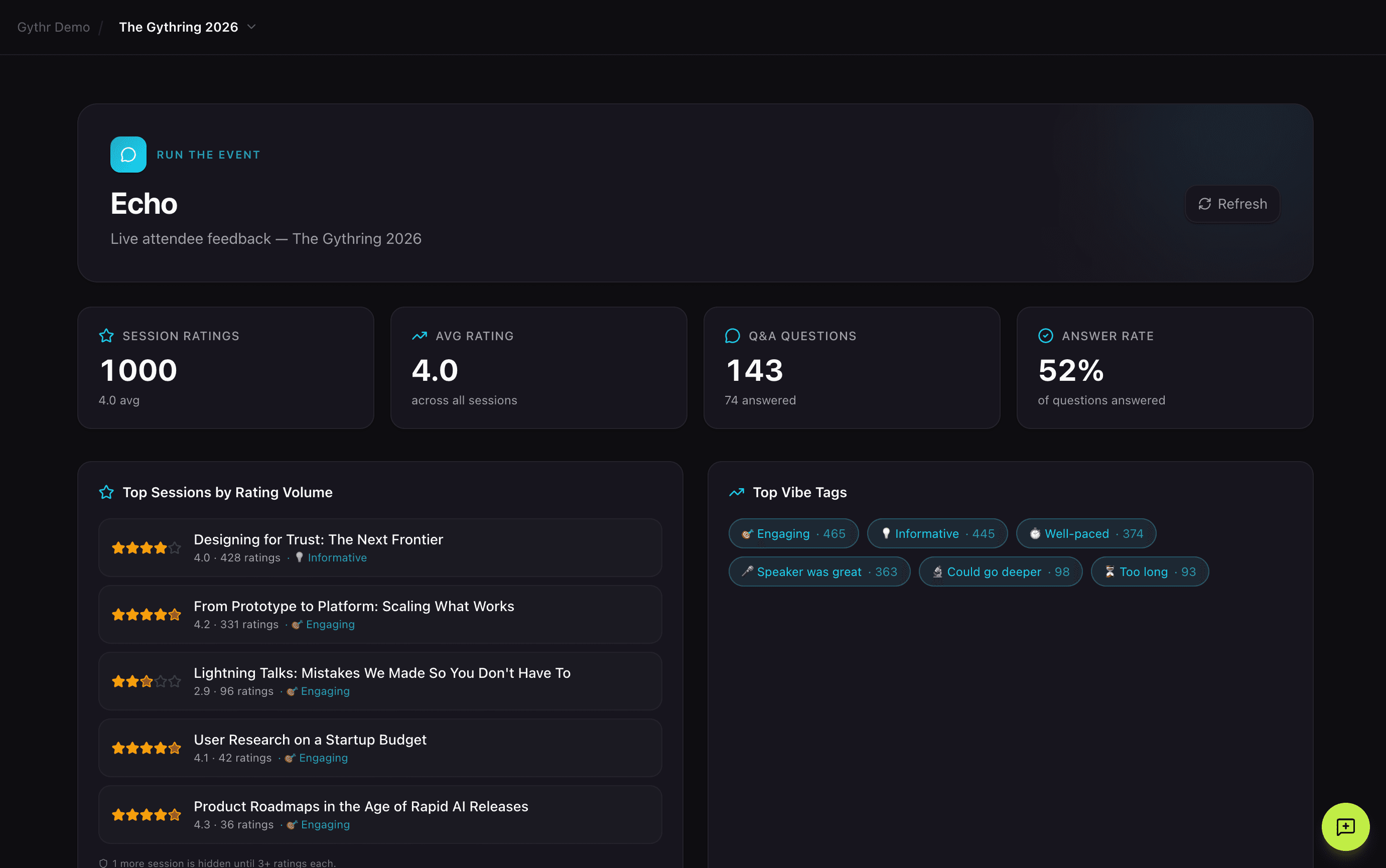
When you open the Echo dashboard, you see the full picture of your event's feedback in one view. Aggregated averages per session. Top vibe tags across the whole event. Recent comments pulled into a live feed. The Q&A moderation queue showing unanswered questions and trending upvotes in real time.
You see which sessions are landing. You see which ones aren't. You see which questions are burning up the Q&A but haven't been answered yet. You see it all while the event is still happening, which means you can still do something about it: move a speaker to a bigger room, surface a question to a moderator, redirect attention to a session that's crushing it.
The dashboard updates live, debounced to every two seconds so a flood of simultaneous ratings doesn't hammer the page. Aggregates only. No individual attendee data unless the individual chose to leave their name.
Speakers see what they need, nothing more.
Every speaker with a session on your event can see their own feedback through their Stage speaker portal. They see the average rating across their session. They see the top vibe tags attendees picked. They see a few aggregated comments. They do not see individual attendee names, individual ratings, or any data that could identify who said what.
This is intentional. Speakers want to know how their session landed. They do not need to know which specific attendee thought they talked too long. The k-anonymity floor protects them from outlier reviews. The aggregate view protects them from singling anyone out.
When Speaker Pulse reports go out after your event, Echo's aggregated data is part of what makes them meaningful. The speaker gets the honest picture, shared with dignity.
What's on the roadmap
Echo today is focused on honest, privacy-first feedback capture. Features rolling out through 2026 include automated post-event report generation, multi-event historical comparison, AI-assisted theme extraction from open-text comments, and deeper integrations with Comms for automated survey triggers.
If you're evaluating Gythr and one of these features is critical to your event, email rebecca@gythr.com. Roadmap priorities are set by what design partners tell us matters most.
Connected Modules
Echo connects to the modules that need the signal.
Stage
Echo's session ratings feed into Speaker Pulse reports through the Stage speaker portal. Speakers see their aggregated data. They never see individual names.
Gate
Echo checks Gate's scan data to verify which attendees were actually in the room when they submitted a rating. Verified ratings are flagged separately so organizers can filter signal from noise.
Signal
Echo's aggregated metrics (average ratings, NPS, Q&A volume) flow into Signal as part of your cross-platform event analytics.
Gythr Here
Echo's rating prompts, Q&A panel, and event pulse check-ins all live inside the Gythr Here attendee app. No separate download, no separate link, no extra login.
Echo is included on Business and Org.
Unlimited ratings, unlimited Q&A questions, unlimited event pulse checks, and full k-anonymity and privacy protections.
Book a demo →Honest feedback. Real privacy. No bad-day bombs.
Give your attendees a way to be heard, your speakers a way to grow, and your sponsors a way to prove their ROI. All without exposing anyone's individual ratings to anyone else. Book a demo and we'll show you Echo running on a real event.